Why Websites Are More Important Than Ever
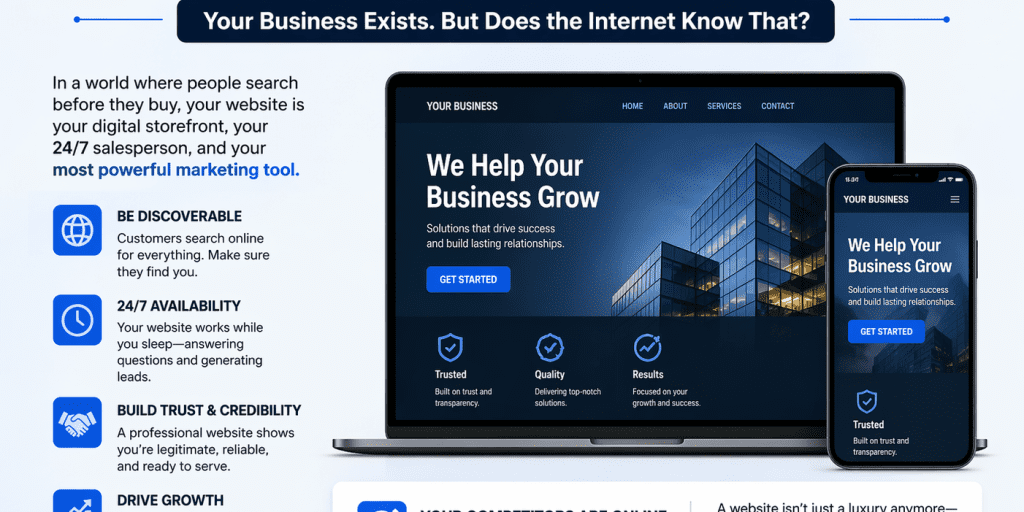
“Your Business Exists. But Does the Internet Know That?”
Reading time: 5 minutes
There’s a moment every small business owner dreads.
Someone hears about you through a friend, gets excited, pulls out their phone — and finds nothing. No website. A Facebook page last updated in 2021. Maybe a listing on some directory site you don’t even remember signing up for.
Just a ghost where your business should be.
It happens more than you’d think. And in 2026, that silence isn’t just embarrassing — it’s expensive.
The Decision Happens Before You Know About It
Here’s something worth sitting with. Most buying decisions are made before any conversation takes place.
A potential customer hears your name. They go home, open their laptop, and type you in. What they find in the next thirty seconds determines whether they contact you, or quietly move on to whoever shows up next.
They’re not looking for a flashy experience. They’re not expecting a Fortune 500 website. They’re looking for proof. Proof that you’re real. Proof that you’re professional. Proof that someone else has trusted you before them.
A website is that proof. And without it, you’re relying entirely on word of mouth to close a gap that the internet has already opened.
What a Website Actually Does For You
Let’s be specific, because “you need a website” has become such common advice that it’s stopped meaning anything.
Here’s what a good website actually does, practically speaking.
It answers questions at any hour. Your opening times, your pricing, your process, what you specialize in, how to book — all of it available at 11pm on a Sunday when no one is answering phones and your potential customer is finally sitting still long enough to make a decision. That window matters more than most business owners realize.
It builds trust before the first conversation. By the time someone reaches out to you, they’ve already spent time on your site. They’ve read about you. They’ve seen your work. They feel like they know you a little. That changes the entire dynamic of the call. You’re not starting from zero — you’re starting from trust.
It works while you’re busy doing everything else. Unlike a social media post that disappears in 48 hours, or a leaflet that gets thrown away, your website is always there. Always working. Always representing you.
And unlike a Facebook page, a Google listing, or a profile on someone else’s platform — you own it. No algorithm decides who sees it. No platform can change the rules overnight. No competitor can sit beside it with a “similar businesses” suggestion.
The Real Cost of Not Having One
It’s tempting to think that if business is coming in through referrals and social media, a website isn’t urgent. But that logic has a flaw.
Every referral you get — every time someone recommends you — the first thing the person they’re recommending you to does is Google you. If they find nothing, or something outdated, the referral loses half its power immediately. You’ve done nothing wrong and still lost the lead.
There’s also the matter of perception. We live in a world where even a local tradesperson, a freelance designer, or a single-chair salon is expected to have a web presence. The absence of one doesn’t read as humble or boutique. It reads as unestablished. And that perception — fair or not — affects whether people take the leap of getting in touch.
The businesses thriving right now aren’t always the best at what they do. They’re the ones easiest to trust at 10pm on a Tuesday, when a decision is quietly being made without them in the room.
What Makes a Website Actually Work
Not all websites are equal, and a bad website can do more damage than no website at all.
The things that actually move the needle are simpler than most people think. Speed — a site that loads slowly loses visitors before they’ve read a word. Clarity — someone should know within five seconds what you do and who you do it for. Proof — reviews, testimonials, examples of your work, photos of you or your team. And a clear next step — a phone number, a booking link, a contact form that actually works.
Design matters, but it’s in service of those things. A clean, honest, well-structured website will always outperform a beautiful one that confuses people.
Where enVisioncloud Comes In
One platform quietly helping local businesses get this right is enVisioncloud.
They build clean, fast, conversion-focused websites for people who’d rather be doing what they’re good at than wrestling with technology. No overcomplicated process. No endless back-and-forth. Just a professional website that represents your business properly and actually brings people through the door.
What stands out is how seriously they take the practical side — the speed, the mobile experience, the clarity of the message. Because a website that looks good but doesn’t convert is just an expensive brochure.
If you’ve been putting this off, or you have a site that you quietly know isn’t doing the job, it’s worth a conversation.
Your business deserves to be found. And finding starts with showing up.
👉 Find out more at enVisioncloud.com
This post is produced in partnership with enVisioncloud. All opinions are our own.
Other Articles You Might Like...